
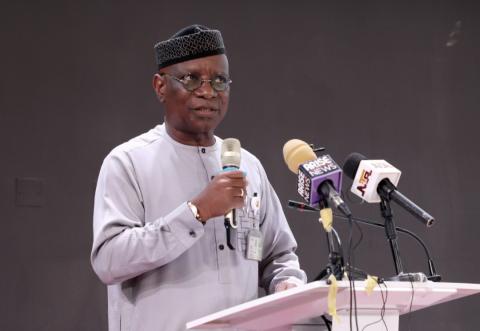
Prof. Oniye, reading the communique
The Open, Distance and eLearning Association of Nigeria (ODeLAN) has聽called on stakeholders to outdo with the obsolete policies and embrace Artificial Intelligence (AI) in schools .
It said continuous and consistent training for Artificial Intelligence (AI) should be prioritised across distance learning institutions.
The聽association said聽integrating AI and updating regulations are crucial to improving聽learning outcomes and ensure the education system keeps pace with technological advancements.
These were聽part of the 20-point communique issued and signed by聽the聽15-man Communique Committee Members chaired by Prof. Christine Ofulue,聽Director, NOUN-RETRIDOL,聽at the end of the 3rd ODeLAN International Conference hosted by the 水果派 of Nigeria.
The conference was聽held between May 14 to 16, 2025 at the headquarters of the聽university聽in聽Abuja, with the theme: 鈥淎daptive Pedagogies for the Future of Education: Connecting Learners, Technologies and Communities.鈥�
A聽total of 280 participants registered for the conference, and over 100 papers were presented.
The communique,聽read by the Prof. Sonnie J. Oniye,聽the聽Dean,聽School of聽Postgraduate聽Studies聽of聽NOUN,聽urged the Federal Government to support institutional access to AI聽tools and prioritise funding for continuous training in technology integration within Nigeria鈥檚 distance education system.
It聽made a strong call for adaptive pedagogies to shape the future of education in Nigeria, calling on institutions to invest in faculty training and digital upskilling for all staff to effectively integrate technology into teaching and learning.
It also called聽for proactive reorientation on ODL, of teachers and all other categories of staff who work within the ODL ecosystem as well as the factors which influence the choice of adaptive pedagogies聽that聽include cost, accessibility, acceptability, user-friendliness, and sustainability.
It also聽identified critical gaps in digital equity, educator capacity, and collaborative research within the Open and Distance Learning (ODL) ecosystem.
ODeLAN,聽in its recommendations,聽called on the聽government聽to聽support the creation of enabling policy environments that foster inclusivity, accessibility, and quality in ODeL, drive regulatory reforms that promote ethical and effective delivery of distance education across Nigeria聽and聽ensure聽that聽political will is sustained in implementing digitisation strategies in education.
鈥淪upport institutional access to AI tools and fund continuous training for technology integration, facilitate access to the Nigerian Education Loan Fund (NELFUND) for distance learners, among others,鈥� the communique said.
It also called on the聽institutions to invest in continuous capacity building for educators at all levels to improve digital literacy and technology integration, adopt and adapt the ACDE Quality Assurance Toolkit to strengthen internal QA processes聽and聽implement robust institutional policies for the ethical use of artificial intelligence in education.
The communique also implored聽ODeLAN to be proactive in contributing to national educational discourse on ODL and related technological reforms, engage with professional bodies to raise awareness and deepen their understanding of the ODL delivery model.
The conference brought together a wide range of stakeholders in Open, Distance and e-Learning (ODeL),聽including policymakers, academics, researchers, education technologists, development partners, and students to engage on the future of education through adaptive pedagogies and technological integration.
It also featured three keynote presentations by distinguished global leaders in聽open and distance learning: Professor Peter Scott, President, Commonwealth of Learning (COL),聽Professor Mpine Makoe, Executive Dean of Education, University of South Africa (UNISA);聽Prof.聽Tayo Arulogun, Vice-Chancellor, MIVA Open University, Abuja, Nigeria.