
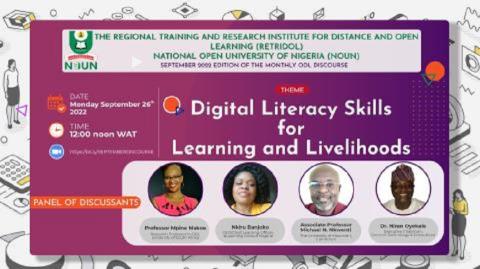
Makore, Banjoko, Nkwenti, Oyekale
As the world continues to witness evident聽changes in聽technology-driven work and employment, panelists at the聽Open and Distance Learning (ODL) Monthly聽Discourse聽have called on every African to be digitally literate in order not to be left behind in the 21st Century struggle.
They made this call on Monday, September 26, 2022 while presenting papers virtually at the September edition of ODL Monthly Discourse, being organised by the Regional Training and Research Institute for Distance and Open Learning (RETRIDOL)聽at聽the 水果派 of Nigeria (NOUN)聽headquarters, Jabi, Abuja.
The panellists were: 聽Research Professor in ODL,聽University of South Africa,聽Prof.聽Mpine Makoe; a don at the University of Yaound茅, Cameroon, Associate Professor Michael N. Nkwenti; 聽CEO/Chief Learning Officer, eLearning Consult Nigeria,聽Nkiru Banjoko聽and聽Executive Chairman, Commit Technology & Consult Ltd,聽Dr. Niran Oyekale.
While speaking on the topic: “Digital Literacy Skills for Learning and Livelihoods,” the quartet were unanimous that “Digital literacy is the ability to define, access, manage, integrate, communicate, evaluate and create information safely and appropriately through digital technologies and networked devices for participation in economic and social life.”
In her presentation, Prof. Makoe, while calling on Africans to embrace 聽digital literacy,聽said it facilitates teaching and learning in educational spaces, adding that “we can use it optimally for the benefit of the teachers and learners.
” I believe that things change as we go along. One of the things that I do is that I do research in the universities of the future and I know that universities of the future are likely to be more digital, are likely to be more open, are likely to be more flexible, so I’m looking at it from that perspective.”
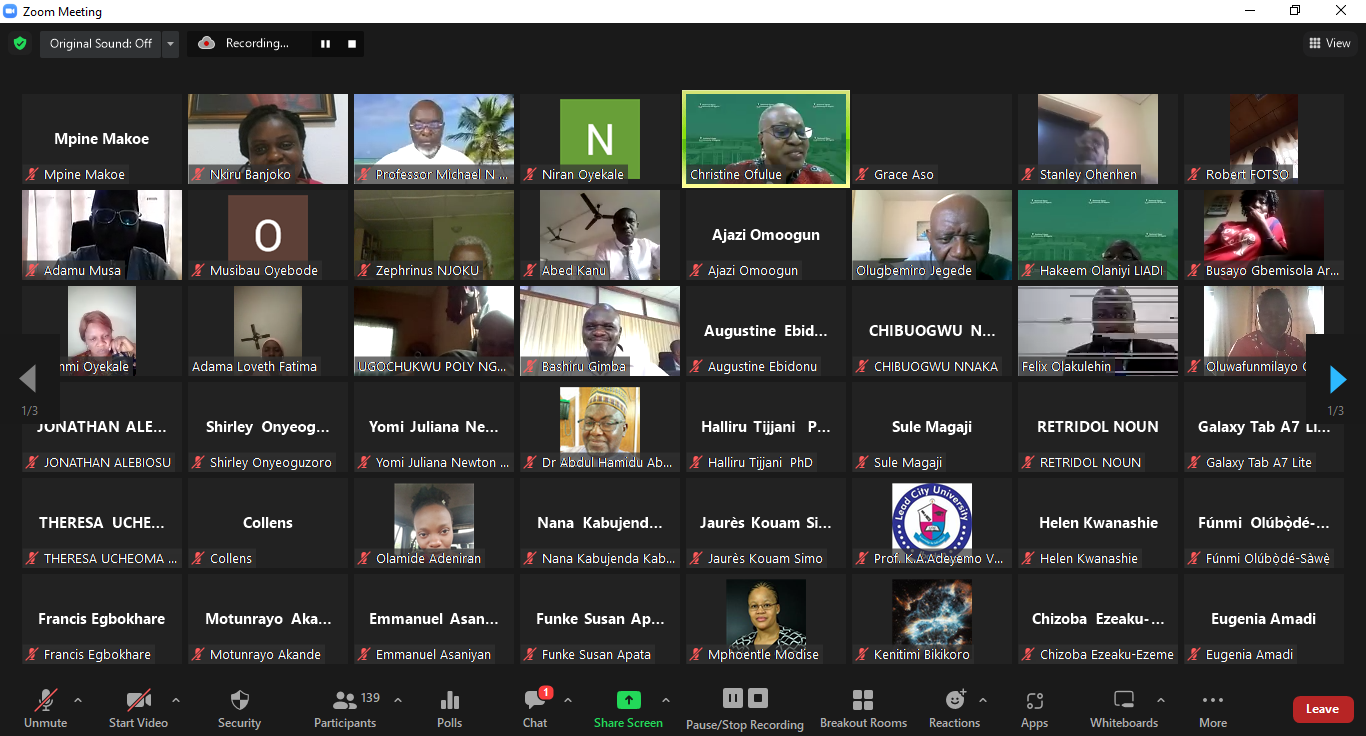
Virtual Participants
While calling on Africans to look inward and improve on what the continent has, Makoe pointed out that Africans’ over-dependence on western world is affecting the continent technologically, adding that “we forget what we have and trying to do research on what we have and improve on what we have.
“As a teacher I need to be literate in those things so that I will be able to impart the learners to see the world differently. I cannot teach the way I was taught because the environment is different and the future demands me to teach differently so that the students that I’m empowering now will be able to do the job that demands.鈥�
On her own part, Dr.聽Banjoko, while calling on Africans to go back to the basics, said that digital literacy is all-encompassing, adding that it involves language literacy, 聽media literacy, information literacy, computer literacy among others even as the literacy brings about enhancements in pedagogy.
In a related development, a Cameroonian-based Professor, Michael N. Nkwenti, who spoke on the need for digital skills, said that everybody needs digital skills in the present-day society to be able to function well.
Nkwenti said that digital literacy is needed 聽in both academics and for individuals鈥� livelihoods as it helps teachers to impart knowledge without depending on the traditional use of paper and pen.
“There is no way you can function in this present society without the digital skills and it is happening in every sector,” he said.
In his own perspectives, while shedding more light on the topic, the聽Executive Chairman, Commit Technology & Consult Ltd,聽Dr. Niran Oyekale聽said “we need to provide every African with the 21st Century skills to be able to navigate well and be future-prove for learning and livelihoods.”
At the end of the discourse, RETRIDOL director, Prof. Christine Ofulue, thanked the discussants as well as the participants for their contributions.