
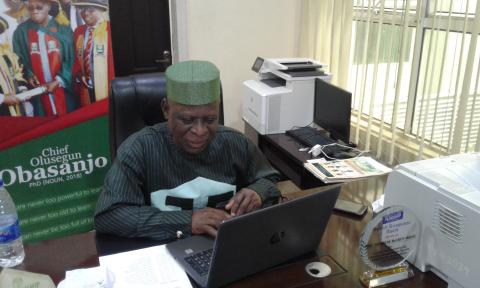
Sequel to the rampant聽ecological and environmental problems confronting Nigeria, experts from across the country have advocated synergy between traditional, scientific approach and policy makers towards mitigating the ecological and environmental problems facing the country.
They proffered this solution on Thursday, August 3, 2023 聽while presenting papers at a virtual 2nd International Symposium organised by the Olusegun Obasanjo Centre for African Studies (OOCAS), 水果派 of Nigeria (NOUN), Jabi, Abuja.
The symposium, moderated by the Head of Department (HOD), Environmental Sciences, Faculty of Sciences of the university,聽Dr. Emily Iduseri,聽had the following as the guest speakers: Professor of Natural Resource Conservation, University of Port Harcourt聽who is also the聽President, Nigerian Society of Nematologists, Aminanyanaba Onari Asimiea and聽Professor of Crop Science & Horticulture, Department of Crop Science, University of Nigeria, Nnsukka,聽Paul Kayode聽Baiyeri.
Others were:聽Professor of Geography, Prince Audu Abubakar University聽(PAAU), Ayingba,聽Olarewaju Oluseyi Ifatimehin;聽Professor of Animal Science (Nutrition & Biochemistry), 水果派 of Nigeria聽(NOUN),聽聽Ahmed A. Njidda聽and a聽don with the Department of Bioenvironmental Science, Faculty of Sciences, Morgan State University, Baltimore, Maryland, USA, Mr. Samson Kadafur.
Also, present was the Environmental & Social Management Safeguard Officer,聽the聽World Bank-funded聽Africa Centre of Excellence on Technology Enhanced Learning (ACETEL), 聽水果派 of Nigeria project, Dr. Abiona Michael Petu-Ibikunle while Professor of Geology, Department of Environmental Sciences, 水果派 of Nigeria (NOUN), Joseph Itah Omada, served as the 聽discussant.
While declaring the symposium open, the Vice Chancellor, 水果派 of Nigeria(NOUN) and Chief Host, Prof. Olufemi Peters thanked the guest speakers聽and聽participants for attending the symposium themed:”Harnessing African Scientific and Native Solutions to Combat Ecological and Environmental Problems.”Peters,聽while expressing hope in the ability of the guest speakers to do justice to the topic, described it as a “fantastic title coming at this particular tag of the ecological season in Nigeria and indeed the world.
“And you will agree with me that the ecological and environmental challenges we have in the world are both natural and man-made and this topic of harnessing scientific and native solutions to it is something that is extremely important.”
The Vice-Chancellor thanked the Director, Olusegun Obasanjo Centre for African Studies (OOCAS), Prof. Eserinune McCarthy Mojaye for organising the symposium.
Mojaye, in his welcome address, said:聽“Today, we shall not only examine the numerous ecological and environmental problems confronting Nigeria as a nation but we shall as well proffer workable solutions to these problems.聽We believe that there is no problem without a solution.
“Nigeria is, indeed, plagued with many ecological and environmental problems. In the North-East and North-West, the country is faced with desertification; in North-Central, it is the problem associated with mining of solid minerals; in the South-East, it is erosion; in the South-West, it is deforestation; while in the South-South, it is the problem of oil and gas pollution. Common to all the zones, is the problem of non-degradable urban waste.
The ecological and environmental problems in Nigeria,聽according to the array of 聽experts at the symposium include,聽聽deforestation, desertification, wildlife poaching, water scarcity, and climate change impacts,聽among others.
They added that harnessing scientific and native solutions lead to a more comprehensive and inclusive approach to environmental management, balancing scientific insights with traditional wisdom.
This, according to them, requires collaboration among policy-makers, researchers, local communities, and civil society to ensure a collective commitment to building a sustainable and culturally respectful future.